Thursday, May 16, 2013

The problem with wearing cheap clothes made in Bangladesh...

From the Nation, 
Should I weep, pray, or go naked?

The Price
JOANN WYPIJEWSKI


"A photograph haunts my waking hours. In it a man is curled embracing a woman. His eyes are closed, his head against her chest. Her back is arched, right arm resting on his left, elbow finding a niche in the crook of his arm. From the pose alone, it is as though he had reached for her in his sleep; as though her wrist, bent down against his brow, might bend again, directing her hand to stroke his hair, his face, his bowing back; as though she and he together had paused to feel the beating of their hearts.


The Kama Sutra must have a name for their embrace, for it is beautiful and common. But catastrophe and not love is the subject of this scene, for these two are dead.
We don’t know how they lived or what they were called, whether they were lovers or strangers taking desperate hold of each other as the ceiling crashed and the walls came down and a bolt of aqua cloth with polka dots loosened like a winding sheet against their tomb of concrete and twisted rebar.
We know them by their work, as garment-makers; by their workplace, Rana Plaza in Dhaka, Bangladesh; by the date they were killed, April 24, 2013, because factory bosses valued the return on whatever rag they were sewing more than life. We know—because their final gestures were exposed enough to be captured by the photographer and activist Taslima Akhter—that their loved ones were among the first of those mourning the 600-plus dead and were not among those wandering for days near the wreckage carrying tattered hopes and a different type of photo, of faces bright and alive, belonging to the scores who were missing. We know that 2,437 workers, some grievously injured, were pulled from the rubble alive. We know that all who sewed in the eight-story Rana Plaza were paid between $35 and $70 a month; that they belong to the second-largest population of garment workers in the world; that the day before the collapse they heard a rumble, almost like an explosion, as the building cracked, but were called in to work the next day anyway; that the factories in Rana Plaza were among 100,000 in Dhaka, this century’s satanic mills, where women, men and children toil long hours, under brute conditions, at punishing speed, stitching cheap fashions that an American will buy today and toss in the trash next year.
Beware the fabulous bargain, union workers in the US garment trade used to say; it conceals a world of pain.

If the dead bodies of Dhaka seem remote as a concern for sexual politics, that merely reveals how shallow those politics often are, and indeed how limited are the familiar, compartmentalized politics of the progressive brand.

As wails of grief and shouts of protest pierced the air half a world away, there were but a few bleats here. Earnest consumers complained about Walmart and vowed not to buy clothes made in Bangladesh. Some unionists called for safety measures and industry-sponsored factory inspections. Confessors of body politics, meanwhile, were prepping for Masturbation Month (May), or planning a Stronic™ Sex Toy Race for Gay Pride (June), or arguing that maybe police ought to arrest the female fan who tried to fellate rapper Danny Brown onstage, or advertising another academic meeting to discuss the elemental stuff of life in a language intelligible only to themselves.
The dead of Dhaka ought to prompt a deeper consideration by everyone of the punishments of capital, and of the relationship between desire, repression and power.

The two people locked in death’s embrace were workers, but the totality of their life was not contained within the harsh parentheses of their labor. It happens that they were a man and a woman; they might have been otherwise. We mourn them not because of their tools or even because of the manner of their death but because they were human, like us; with desires, like ours, for kindness, justice, pleasure, desires attenuated and finally foreclosed by human systems—cruel ones, but not functioning by fate. Having been made by acts of human will, they can be unmade. It seems necessary to say that.

These two, these 600, the countless unremembered others, might have been people caught in any horror, dead and deserving of our sensitivity. But they occupied a particularly revealing, almost intimate, position in the circulation of commodities. They were terribly poor in a worldwide system that shields us from their poverty and that ordinarily renders them invisible even as it provides multiple, tangible and highly visible signs of their presence: the work of their hands.
And what a work that is! The garment—comfort and adornment, practical necessity and object of allure, medium for self-presentation (why this shirt and not another?), designed to attract, marketed through sex and wrapped up in eroticism if only because of the flesh it conceals.
Before the building in Dhaka collapsed, telephone stands and subway walls near Union Square in New York sprouted ads for H&M. The model, Vanessa Paradis, rises like a haughty Venus in flowery prints within a bower of spring blossoms. She is the face of H&M’s Conscious Collection: “more sustainable fashion,” made from organic cotton and recycled polyester at $29.95 for the faux-jeweled jacket; $19.95 for the sweeping sundress; $9.95 for the flirty blouse.

H&M may not have had subcontractors at Rana Plaza on April 24, but it places more orders with factories in Bangladesh than any other apparel company in the world. Its “manager of sustainability and social issues,” Pierre Börjesson, told the AP last December that the company would not sign on to a plan for independent, industry-financed factory inspections drawn up by the International Labor Rights Forum because safety should be a public responsibility. It’s estimated that the plan would have added ten cents to every garment made by every company if spread out to include all Bangladeshi apparel exports. The ten cents was never the issue, which is why the inspection regime, while beneficial, also hits short of the mark. To keep the rate of profit ticking to the max, someone somewhere has to die, if not dramatically then slowly over years at their machines, if not their bodies then their souls, as cash gets shoveled upstairs and shoppers get a pretty distraction. H&M’s face for summer is Beyoncé as Mrs. Carter: $4.95 for the bikini top.

Almost ten years ago, Tony Kushner wrote an essay for this magazine called “A Socialism of the Skin.” It repays rereading. In part an extended argument with gay conservatives, it is so much more: a political appeal to conjoin the pursuit of pleasure with an active hatred for misery and the structures that require it. The man and woman who held each other as their last act as fellow workers, as human beings and heirs to life, call out to us. Let their epitaph be our standard. They died for capital; we must live and work for freedom, love, solidarity."

Saturday, April 27, 2013

Signs that one has undergone a spiritual awakening

Perusing the list below, I realize I might have a ways to go...

Saturday, April 20, 2013

Hallelujah

Here is a tribute to Boston after the tough times endured this week, starting with the bombs at the marathon :

The rendition of Hallelujah in the video on MLB.com is by a singer who I had never heard of, Jeff Buckley. He died in a drowning accident after releasing only one album, Grace, which included his haunting 'cover' of this song originally written by Leonard Cohen.

And here are the lyrics:
Well I've heard there was a secret chord
That David played and it pleased the Lord
But you don't really care for music, do you?
Well it goes like this:
The fourth, the fifth, the minor fall and the major lift
The baffled king composing Hallelujah

Hallelujah
Hallelujah
Hallelujah
Hallelujah

Well your faith was strong but you needed proof
You saw her bathing on the roof
Her beauty and the moonlight overthrew ya
She tied you to her kitchen chair
And she broke your throne and she cut your hair
And from your lips she drew the Hallelujah

Hallelujah
Hallelujah
Hallelujah
Hallelujah

But baby I've been here before
I've seen this room and I've walked this floor
You know, I used to live alone before I knew ya
And I've seen your flag on the marble arch
And love is not a victory march
It's a cold and it's a broken Hallelujah

Hallelujah
Hallelujah
Hallelujah
Hallelujah

Well there was a time when you let me know
What's really going on below
But now you never show that to me do ya
But remember when I moved in you
And the holy dove was moving too
And every breath we drew was Hallelujah

Hallelujah
Hallelujah
Hallelujah
Hallelujah

Maybe there's a God above
But all I've ever learned from love
Was how to shoot somebody who outdrew ya

And it's not a cry that you hear at night
It's not somebody who's seen the light
It's a cold and it's a broken Hallelujah

Hallelujah
Hallelujah
Hallelujah
Hallelujah
Hallelujah
Hallelujah
Hallelujah
Hallelujah
Hallelujah
Hallelujah
Hallelujah
Hallelujah

Hallelujah

Thursday, April 18, 2013

Two wolves


Native American wisdom speaks volumes to all of us ...

An old Grandfather said to his grandson, who came to him with anger at a friend who had done him an injustice, "Let me tell you a story.

I too, at times, have felt a great hate for those that have taken so much, with no sorrow for what they do.

But hate wears you down, and does not hurt your enemy. It is like taking poison and wishing your enemy would die. I have struggled with these feelings many times." He continued, "It is as if there are two wolves inside me. One is good and does no harm. He lives in harmony with all around him, and does not take offense when no offense was intended. He will only fight when it is right to do so, and in the right way.

But the other wolf, ah! He is full of anger. The littlest thing will set him into a fit of temper. He fights everyone, all the time, for no reason. He cannot think because his anger and hate are so great. It is helpless anger,for his anger will change nothing.

Sometimes, it is hard to live with these two wolves inside me, for both of them try to dominate my spirit."

The boy looked intently into his Grandfather's eyes and asked, "Which one wins, Grandfather?"

The Grandfather smiled and quietly said, "The one I feed."

Wednesday, March 27, 2013

Sunday, March 10, 2013

Facing the possibility of death sooner than I expected

and how I plan to cope...

So, dear F(friends) and family,

My chronic leukemia has transformed into an aggressive lymphoma with a variable prognosis. Depending on how the chemotherapy I just started works and if I go through a stem cell transplant afterward I could have as little as 4 months to live or as much as several more years. Details on my condition are on my blog My CLLTrail.

So what does death mean to me, a Quaker with more recent tendencies to Buddhism?

For all humans when life is cut shirt there is to be expected a fear and dread of  loss of things we were planning to accomplish and  losing contact with still living loved ones. Another loss for me, less than 3 years from retirement, would be the chance to enjoy a few years of doing something other than my usual work (20 years pediatric practice, 10 years of online medical education), like travel, try writing a novel, etc.

Thinking about death leads me to ask myself what I really believe about God, the soul, and afterlife.

Do I believe in God ? Yes but not the Judeo-Christian Great White Father on his heavenly throne, nor the pagan Mother Earth. Rather an underlying Spirit, more like a life force. Here is where my biomedical training comes in; I really like the concept of biocentrism, more a scientific theory than a spiritual stance, which combines physics and biology and states that life created the universe, not the reverse. 

But other than a wonder at the complexity of life and the unlikelihood of it, and those moments in solitary meditation and prayer as well as in Friend's meetings for worship, when there is a real nonverbal experience of that Spirit, the Inner Light (read here and here if you are not familiar with Quaker "theology"), I often tend toward agnostic thinking. My science background and just going through life, forgetting about God/Spirit seem to be responsible for these frequent lapses, probably many humans do this. And of course, all the hypocrisy and violence of "religious people" - Jews,  Christians and Muslims in today's world. The Right to Life but wars OK crowd and the jihadists....

Do we have souls that live on after our biological death? Does the existence of God necessarily predispose to souls and immortality? Perhaps not. One of my coping mechanisms for dealing with death is to do this Yale open online course, PHIL 176: Death. 

Then there is the "science" of near-death experiences, the light at the end of the tunnel that people experience. I may do some more reading on this, but as a physician I am skeptical about these episodes confirming the presence of an after-life, could it not just be the effect of low oxygen on the brain?  A bit more intriguing and on my future reading list, is the story about the near after-life experiences of the neurosurgeon, Dr Eben Alexander, who after coming down with meningitis, experienced what sounds like heaven. I am still skeptical though because hallucinations are certainly symptoms that can be seen in meningitis!

But my increasing interest in Buddhism and mindfulness meditation may be the real key for me. If there is to come an afterlife I do think I prefer the idea of multiple reincarnations, landing where karma from the recent life may lead...

Mindfulness meditation based on Buddhism has been used quite successfully in many areas of medicine and also have helped terminal patients face death. From a pre-publication chapter on  Mindfulness for Cancer and Terminal Illness, comes some helpful direction.

In this chapter, mindfulness is defined as "the awareness that arises through intentionally attending in an open, caring, and nonjudgmental way. This definition was meant to take into account mindfulness as both a way of being in the world and as a process or practice."  Here are the ideas behind the apparent success of this program:

The question remains: Why would mindfulness ... as described above, be especially helpful to people coping with cancer?  As it turns out, many of the issues cancer patients face are best dealt with through approaches that emphasize acceptance and awareness, as well as non-attachment.  Non-attachment arises from an understanding of impermanence, the constantly changing nature of all things.  With an understanding of impermanence, patients are able to loosen their stranglehold on needing things to be or stay a certain way, or needing to know exactly the outcomes of their treatments and their prognosis for the future. With a more present-moment stance and through the practice of seeing things clearly as they are, simply allowing acceptance of circumstances, patients are able to stop struggling with questions of “why” And simply dwell in the “what” of each moment.  Worry often arises from questions around the future – these can be attenuated through focus on the present-moment and learning to allow events to unfold moment-by-moment.
Guided meditation holding thoughts of loving kindness has great appeal. From  Being with Dying: Cultivating Compassion and Fearlessness in the Presence of Death comes some examples of such phrases held in contemplation during meditation:

“May the power of loving kindness sustain me.”
“May I be peaceful in body and mind.”
“May I receive other’s love and compassion.”
“May all those I leave behind be safe and peaceful.”
“May I be free from suffering.”
“May I be free from fear.”
“May I accept my pain, knowing that I am not my pain, not my body, not my illness.”
“May I accept my suffering, knowing it does not make me bad or wrong.”
“May I accept my anger, fear and sadness, knowing that my heart is not limited by them.”
“May I remain in peace, and let go of expectations.”
“ I ask forgiveness from those whom I have harmed.”
“ I freely forgive all those who have harmed me.”
“ I forgive myself for mistakes made and things left undone.”
“May I remember my consciousness is much vaster than this body, as I let go of this body.”
“May I open to the unknown, as I leave behind the known.” 
“May I, and all beings, live and die peacefully.
Great stuff, methinks!

So I plan to read more on this approach, both the clinical mindfulness approach and some Buddhist texts, as I keep working on this form of meditation. I expect these to be very helpful no matter how much time I have left.....

Most importantly I have to be grateful for each day I have, no matter how I feel, no matter the weather, no matter whether at work or play....and keep up my prayer and meditation practice almost compulsively

Try to live each day in complete mindfulness, and expect the rest of my life to be a real adventure to savored.

Thursday, November 22, 2012

Giving thanks: classic American gluttony or sacred ritual?

On this beautiful Thanksgiving morn, amid family visitors, bustling food preparation, classic Tday television I can't help but reflect on the true meaning of this day. Many might say that the only legitimate prayer is one of thanks and gratitude; prayers of petition for example always confuse me - if we are to do the will of our supreme being where do we come off asking for another outcome....But even those in a state of misery can give thanks, there is always some thing to be thankful for, if only for the day...

At any rate I love the way "thank you" is said in other languages: merci, danke schön, gracias, and many more. My favorite is the Lakota "pilamaya". We humans have much to be thankful for and many errors to correct - here I am thinking of how we have screwed up our planet, but today I am thankful we still have a planet...

Yesterday when I was grabbing some last minute groceries at the Shop Wrong along with throngs of obese/overweight others filling cartloads of crappy processed food the word GLUTTONY came to mind. Abhorrent in light of pockets of famine worldwide. But my family will cook our organic free range turkey with all sides prepared from equally organic veggies and breads (not to mention gravy made with an imported beer first brewed in the 13th century at a European monastery), not our batch, though..) are only different by degree...snobbish foodies perhaps but all yearning for taste and that ense of fullness.

But breaking bread with family annd friends is a sacred act...in many religions, many social settings. As this excerpt from  a Catholic blog states:

"Sharing a meal: That’s how so many people of faith know and experience God. It has been that way for thousands of years. We come together as people of faith and we tell stories and recall history; we ritualize and make sacred our food and drink. We make a meal the fullest and most eloquent encounter with Divinity. We feast on, and are nourished by, God’s love. There doesn’t have to be a lot of theology around it. The philosophical constructs and intellectual categories used to explain how a meal can be holy are almost pointless. For most of us, it is crystal clear. All one needs to do is watch a young couple in love sharing a romantic dinner, or see an elderly couple gaze at each other across the table at their anniversary and you will know you are on holy ground. Observe a family enjoying a child’s birthday celebration at a local pizza parlor; hear the laughter and see the smiles and you sense something good, something spiritual about it all. More often than we realize, our meals are encounters with God. The act of eating and sustaining our bodies cannot be separated from our spirits. The biblical authors knew this well and constantly remind us that our meals are spiritual. Our food and drink have consequences."

All our meals are spiritual...indeed with the correct perspective all our life is sacred. This feeling of spiritual rightness is multiplied manifold when more of us gather together for a holiday meal.

Sunday, January 1, 2012

Occupy your (higher) Self. 100 %.

Occupy your heart.
Occupy the place where everything is connected.
Occupy your own rhythm.
Occupy compassion.
Occupy your creativity.
Occupy whatever is in front of you RIGHT NOW.

Occupy your feelings.
Occupy stillness.
Occupy the truth that you are good enough.
Occupy your physical body.
Occupy uncertainty.
Occupy the space in which you are never alone.

Occupy grace.

Occupy your OWN energy.
Occupy all points of view.
Occupy your intentions.
Occupy what makes you feel most alive.
Occupy your inner knowing.
Occupy a raindrop.

Occupy your dreams.
Occupy acceptance.
Occupy what needs to be said
Occupy sound and light and color and space.
Occupy a sense of purpose.
Occupy kindness.

(breathe now)
Occupy your breath.
Occupy this inhale.
Occupy this exhale.
(breathe now)

Occupy the space you are most afraid to occupy.
Occupy gentleness.
Occupy your relationships.
Occupy the ether and the deep ground.
Occupy your truth.
Occupy change.

Occupy your deepest passion.
Occupy forgiveness.
Occupy the divinity of all living things.
Occupy your word.
Occupy the unknown.
Occupy your readiness to heal.

Occupy silence.

Occupy whatever is downstream.
Occupy tranquility.
Occupy the understanding that there is always enough.
Occupy timelessness.
Occupy your power.
Occupy your seat on your journey Home.

Occupy the mind that recognizes these words.
Occupy the eyes that sees this grand vision.
Occupy the ears that hear this possibility
Occupy the mouth that speaks only light.
Occupy the hands that long to share.

Occupy the You that lives to love.

Occupy the moment.
Occupy gratitude.
Occupy joy.
Occupy your fear and transform it into love.
Occupy. The beat. Of Your. Wild heart.
Occupy NOW.

Occupy your (higher) Self. 100 %.

---- Peggy Fitzsimmons

(transcribed from the video posted at http://www.huffingtonpost.com/2011/12/30/occupy-your-higher-self-video_n_1176664.html)

Sunday, December 25, 2011

Should good pacifists (Friends) be fans of pro football and hockey?

Fellow members of the peace churches, I am in  a quandary. I love to watch professional football (American) and ice hockey.  But both sports have their violent tendencies whereby it is considered good form to tackle a football player carrying or catching the ball as hard as one can (hoping to dislodge the ball, perchance to knock them out of the game?) or smash a hockey player with the puck up against the boards to try to wrest the puck away.  Multiple concussions seem to be happening more and more even though the leagues have instituted many new rules. In football players are watched more closely if they suffer a first concussion, but there is evidence that many players hide their concussions so they can keep playing.  Multiple concussions close together can be fatal and over time the syndrome of chronic traumatic encephalopathy (CTE) which leads to a dementia state not that different from Alzheimers. Recently there have been lawsuits by formal NFL players against the league for allegedly hiding and/or ignoring evidence for CTE.

As for hockey, in addition to the inherent violence in the sport with speedy heavy players skating on ice and slapping hard rubber pucks at the goal and each other, there is fighting. Not allowed in collegiate or international/Olympic hockey, but very big in junior and minor league hockey as well as the NHL (major league).  A recent series in the NY Times highlighted the story of Derek Boogaard, a hockey enforcer, who sustained multiple concussions over six NHL seasons and many junior and minor league seasons as well. He died of an overdose but was showing clear signs of an encephalopathy along with his addiction. His brain at autopsy showed clear evidence of CTE.

To glorify violence and be a non-violent person who abhors all war is quite philosophically inconsistent. I love pro sports perhaps because I am still a boy at heart, I don't know....but I am having to seek clearness on this for myself.

But the fighting is too much. These sports are dangerous enough. I say maybe fans should boycott NHL until they outlaw fighting and continue to call for good referee calls of excessive force in the NFL.

Sunday, October 16, 2011

Mitakuye Oyasin

I just watched a recent 20-20 show on the Pine Ridge Indian Reservation, where I spent two years in the late 70s. The show was about the children, their dreams, the poverty and alcoholism. Moving to say the least. The land is hauntingly beautiful as are the people and their views of the Earth, the Great Spirit (Wakan Tanka), and the sharing of wealth....not all of this was covered in the story...the story brought back my memories.

Here is the link to the ABC news, you may need to do some clicking around because it will no doubt move on the site...

I had some moving spiritual experiences during my times at Pine Ridge, and read several great novels that make me wish us white men (wasicuns) had tried to listen to our Native American brethern before we took their land, commited mass genocide and even worse abuse Mother Earth in our incessant industrial evolution. The books were The Wolf at Twilight by Kent Nerburn and Black Hills by Dan Simmons.

and this TV show brought it all back ..

Mitakuye oyasin is Lakota. It means "All My Relations." It is a prayer of oneness and harmony with all forms of life. Hard to disagree with that

Monday, October 25, 2010

Health care reform per Robin Cook

I practiced pediatrics in several settings including government, HMO and private practice for over 20 years. In my semi-retirement forced on me primarily by my personal medical situation, and as an extreme liberal, I found this short (relatively) diatribe on the current state of the US health care nonsystem to be, quite frankly, RIGHT ON!

In his most recent novel, Cure, the prolific medical thriller writer, Robin Cook, had this to say about a doctor who got into legal trouble because of his greed:

"The fatal flaw of greed evidencing itself in an individual who most likely started out with an altruistic desire to help people, just like ninety-nine percent of other medical students."

"It's the unfortunate marriage of medicine and business. In the mid-twentieth century you could do well in medicine, but you really couldn't become truly wealthy. All that changed when medicine in this country did not emerge as a responsibility of government, like education or defense, as it did in most every other industrialized country. Add to that the US government inadvertantly contributing to medical inflation by passing Medicare without effective cost controls, by generously subsidizing biomedical research without maintaining ownership of the resulting discoveries for the American public. and by its patent office awarding medical process patents life for human gene sequences, which it is not supposed to do by law. I tell you, the medical patent situation in this country is a total mess, which is already starting to haunt the biomedical industry, but that is another issue."

"Unfortunately today if a doctor wants to become truly wealthy, and a lot of them do, it is reasonably within their grasp by choosing the right specialty, getting involved in the pharmaceutical industry, the health-insurance industry, the specialty-hospital industry, or the biotech industry. All these industries say they exist to help people, which they can, but it is more of a byproduct, not the goal. The goal is to make money, and do they ever."

".....most if not all medical students are altruistic to begin with , but they are also competitive. They have to be, to get into the best college, to get into medical school, and to do the best to get the most coveted residencies to get into the best medical specialty, meaning, most likely, the one that pays the most so they can pay down their student loans the fastest. What they don't realize is that the profession in this country has drastically changed over the years, mostly because of economics."

Note: when the discussant was asked if health care reform legislation could fix this problem, the good doctor replied:

"In a generous moment, I might say it is a start At its core there is the goal of some sense of social equality in regard to medical care as a resource and a responsibility of government. But in this country medical care is a competitive stakeholder industry, and the new legislation does not change that; it just resorts the relative power of the stakeholders. I'm afraid the ultimate effect is going to be more pressure for costs to rise, since, like Medicare, there are not enough spcific cost controls."
None of this is new, much of it reflects the views of many medical economists (Ewe Reinhardt and Paul Krugman) and curmudgeonly docs like Arnold Relman, Marcia Angell, and John Abramson (to name but a few). But it is an interesting way for a fiction writer like 'Robin Cook (himself a trained MD) to work in some economic/political analysis into a story.

Wednesday, July 28, 2010

Why are some Friend so unable to forgive?

So unable to listen to people who care about them?


I am upset because I got in a war of posts with a Friend who I thought was a friend, about 10 months ago. It was over a decision by he and his wife not to have their children immunized against swine flu. I took exception to his claim that he was invoking a religious exemption.

Here is one email I sent:

Dear M*****

I am sorry for my nasty words yesterday. I let my anger get the better of me, and must admit a bit of ego got in the way as in how dare you question my expertise, as well as that of the medical establishment in general . I don't want to lose our friendship over this.

But I am still quite worried about your children and would beg you to reconsider your stance on these vaccines. Have you refused other vaccines. I pray not, some are truly lifesaving. And then there is the issue of unvaccinated children passing their infections on to other children. Remember we vaccinate all children to protect one another. This is public health basics, so please know it is not just your children a shot protects. What it the proper Christian approach to this opportunity to help one another? And would you feel bad if your child say got chicken pox and gave them to a child who for some reason was more susceptible (no vaccines are perfectly effective) and got a fatal superinfection? What about whooping cough, babies die, do you want one of your friend's young children to get it from yours?

And from a larger perspective, Glanz says the findings also show "that the decision to refuse immunizations could have important ramifications for the health of the entire community. Based on our analysis, we found that 1 in 10 additional whooping cough infections could have been prevented by immunization"

But finally I want to point out the lack of truth in claiming a religious objection to having your child vaccinated. I know there is no doctrine on this in either the Catholic or Quaker faiths. (not much doctrine at all for us Quakers, LOL). Saying your dialog with God led you to this decision should undergo discernment with a priest and in a Quaker clearness gathering. Have you done that. If you say your faith in God is so strong you do not need vaccines, I have to ask you why go to a doctor at all?I cannot see picking and choosing to which aspects of medical care to let your children have is based on true spiritual guidance. Bottom line, this claiming of religious objection has the loud ring of untruth about it

Again, all my passion on this is a true concern for your children's health....

never heard back from him. Sent this when I was not given access to a blog this person runs:

M*****

I tried to join a few months ago and did not receive notification. I can only hope I am not being excluded because of our disagreement over your decision to not immunize your children. That would not be in keeping with open dialog in Quaker tradition. Nor I might add in the spirit of eldering....I hope if you have control over who gets in this web site you will forgive me my anger....and allow me to join the conversation. Let's bury the verbal hatchets so to speak

Peace, Wayne
and then I tried once again to join and was SUSPENDED, allowed no access to even view posts. Unbelievable, no attempt to even dialog with me. I tried to apologize but no forgiveness. See my rejection:


Then I got sneaky. Tried to sign up under a fake name, using a different email account and a different browser. Here is the response I got:

Saturday, April 17, 2010

Why I am glad Friends don't do icons...

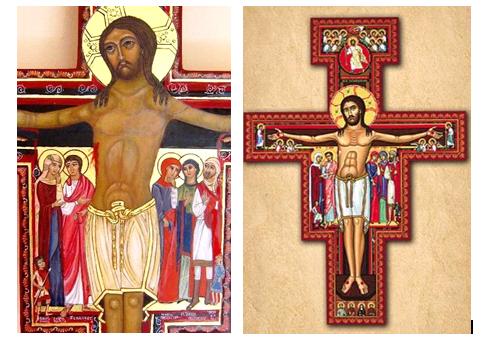
I was looking through some posts on the Young Turks and the Huffington Post the other day and came across this very strange story. It seems the St. Charles Borromeo Catholic Church in Warr Acres Oklahoma has been experiencing some controversy over a crucifix that was placed over the altar recently. A local artist was said to have created the iconic crucifix copied from the historic original San Damiano cross. This was the cross St Francis of Assisi was said to have been praying in front of when he received a message from God to rebuild the church. The original is now in the Basilica of St Clare in Assisi. The controversy surrounds the abdomen of Christ, the question being whether there is a large male genitalia there or just a distension, somewhat like the "6 pack" abdomen of muscle bound weight lifters. You can see the crucifix in question below:
Well I don't know about the average Internet user or the average Quaker but I am a physician and I have to tell you - that is not a "distended abdomen" and certainly not a "six-pack" but rather a male penis and testicles!! I had to research this some more so here are some examples of six packs:
I wondered if the original San Damiano cross was as obvious and after spending some time on the Internet searching for an image of the original I found it and here it is with a close up of the abdomen to the right:

Definitely more subtle but still very suggestive, no? A friend and I talked about this and wondered whether the modern artist was trying to make a statement, given the ongoing sexual abuse scandal rocking the Catholic church around the world.

Here are two other icons that are copies of the San Damiano but as you can see the one on the right shows what looks somewhat more like a 6 pack, and the one on the left is somewhat in between penis and 6 pack:


So other artists since the original have been a bit more discrete in their interpretation. This gets us back to the modern artist. In her interpretation was she deliberately making a point? It turns out that this icon has provoked commentary in the past, see here. In 2006 a documentary, Rape of the Soul, was released. In this film, the Catholic church's sex abuse crisis is blamed on satanic and occult imagery embedded in its artwork. In a comment on the film another iconic crucifix with suggestive imagery is presented. This is the Bigalia Crucifix in Italy and dating from the 13th century. It looks pretty similar and maybe even more suggestive with the "testes" arising from under the loin cloth.:


So the question still remains did the artist embelish her rendition to make a point or was she just following iconic tradition? In the first article on the Warr Acres controversy:

Janet Jaime, a local iconography artist who designed the crucifix, had no comment.

"I think it was painted according to the certain specific rules of iconography and church art,” Seeton said of the crucifix.

The crucifix is about 10 feet tall. It has been hanging above the altar since Feb. 21.

Seeton said the crucifix doesn’t concern him, and there are no plans to remove it.

Monsignor Edward Weisenburger of theOklahoma City Archdiocese also said he has no problems with the crucifix

But thankfully, for the church and all those who understand human anatomy, the story today from Oklahoma is that the crucifix has been taken down and will be altered by the artist, who is said to be distraught over the controversy. A fellow artist who knows her said today that she put too much contrast in the abdomen and was working too close to realize how it looked from farther away. He added, "She is very serious about her religion and wouldn’t in the slightest possibility ever imagine wanting to sneak a pee-pee on to Jesus.” You can draw your own conclusions here...thankfully this is not something we would ever have to deal with in our meeting houses!

Sunday, January 31, 2010

More "Christian" work

http://www.abc.net.au/news/stories/2010/02/01/2806227.htm?section=world

Their "Saviour" is no doubt, as they say, "spinning in his grave" or just angry up there sitting on the right hand of his Father

How violence begets violence

I have just read a disturbing article in this Sunday NY Times magazin The Jihadist Next Door, about the son of a Syrian immigrant, Omar Hammami, who went from normal American life (such as it is, he was raised as a Southern Baptist and Muslim at the same time!) in Alabama, to being a violent jihadist in Somali.

As a young idealist high school and college student he began a process of finding his spiritual niche, at first somewhat of a militant some time after 9/11 when he is quoted as saying:
Soon after, the hijackers struck on 9/11, and local reporters began calling Hammami for comment. Publicly, he struck a measured tone, telling the school paper, “It’s difficult to believe a Muslim could have done this.”But he was caught off guard by the attacks and felt insufficiently knowledgeable about Islam, friends recalled.
but then he got involved with the American Salafi movement and became more involved with Islam meeting a convert named Sylvester. This branch of the Salafi were not violent:

Several of Sylvester’s students said in interviews that he subscribed to a nonviolent school, one that represented the majority of American Salafis. They tend to believe that Muslims should remain politically disengaged and take up arms only when called to duty in a Muslim-governed country; anything else represents rebellion against the government, which violates Islamic law.
But he struggled with finding his identity and at one time embraced some militant thinking, and then with further study of Islam,
Hammami soon began denouncing the militant Islamists he once defended. He came to believe that Muslims were suffering because they had lost their religion, Culveyhouse and Stewart recall. The solution, Hammami now argued, was not to take up arms but to engage in a spiritual jihad, practicing the faith with greater devotion.
He ended up leaving home and moving to Toronto and marrying a Somali immigrant. It was in the Muslim community in Canada that his radicalization began:

Over the next few months, Hammami became consumed with events in Iraq and Afghanistan. He began subscribing to conspiracy theories about 9/11, Dena and Culveyhouse recall. He soon found himself rethinking his nonmilitant Salafi stance.

“I was finding it difficult to reconcile between having Americans attacking my brothers, at home and abroad, while I was supposed to remain completely neutral, without getting involved,” he wrote in the December e-mail message responding to questions posed to him through an intermediary.

There is the crux of my post: think of how these young men all over the world including those raised in our own country would not have embraced the violent Jihad if we had not attacked Iraq or Afghanistan. This fellow, the doctor at Fort Hood, the underwear bomber, and many many more men, may have found the peaceful path of Islam and stayed there were it not for our "Christian" just wars.....

Monday, November 30, 2009

Alive at 60 years of age!

Well today is my 60th birthday, decided to take the day off and enjoy myself, but as usual I am unable to sleep much later than when I usually get up for work.

I never expected to get here, to be frank, because of my chronic leukemia, but thanks to some great pharmaceutical products, albeit very expensive, here I am.

Am reading a book about health care technology and high costs, Taming the Beloved Beast, by Dan Callahan (http://press.princeton.edu/chapters/i9016.pdf) , and am wondering, given the need to curb Medicare costs, whether I will be able to afford those same meds should I make it to retirement age........it's not up to me, but my Higher Power...I am going to continue to live life one day at a time...and enjoy each day the Sun shines somewhere.

Hey I always wanted to grow old gracefully, but I didn't grow up gracefully nor did I handle middle age too well, so the odds are I may not be the peaceful Quaker curmudgeon I want to be, but I will certainly try. Need to learn to let my arrogance and anger go and continue to spend some time each day in prayer and meditation.

I am trying to deal with my anger re: the inability of the Obama administration to get meaningful health care reform passed, not health insurance reform, and then the escalation of Vietnamistan...

Peace to you all, Wayne

PS Bah humbug, I detest the commercialization of the pagan solstice holiday, stolen by "Christians" to perpetuate their divine birth myth....

Sunday, October 25, 2009

Religious objection to childhood vaccines

Some Quaker friends recently posted on Facebook that they have refused some (maybe all?) vaccines recommended for their children on the basis of religious exemption. This got my righteous anger up. Disclaimer here, I am a retired pediatrician, and a member of the medical establishment.

When I was in practice I had a few parents who refused vaccines despite my careful explanation of the benefits and risks. One that I distinctly remember was an Hassidic Jewish mother who claimed, although there was no basis for vaccine refusal in their doctrine, that a rabbi had advised her to follow her conscience on this. I thought this odd, but at least she claimed to have pursued some discernment for what she claimed had felt was God's will for her children.

There is certainly nothing in the rudimentary doctrine of Friends that supports not vaccinating our children. Medical care is a gift from our Creator, improving and saving lives. Picking and choosing which medical care to help their children seems not to be based on true spiritual discernment. I think rather my friends have gotten caught up in the Internet-enabled anti-vaccine movement. I asked them to seek true discernment and accused them of being less than truthful.

Another issue with vaccine refusal is the jeopardizing of others health. Vaccines are a public health concept. We get vaccinated to protect ourselves and others. When particularly susceptible children who do not have protection against a particular illness either because of age, underlying illness (AIDS, cancer) or lack of efficacy of their own vaccine (none are perfect) catch something from the unvaccinated, well that is just wrong. When we protect our own children we help others as well.

Although claiming a religious exemption might have legal grounds, I am not clear that it has moral grounds.

Who would Jesus vaccinate?

Sunday, August 31, 2008

My first post since started this blog again

I had deleted the prior blog, titled Friendly Curmudgeon because I thought I had drifted from a focus on spiritual aspects of my life, with way too many political rants, and ravings about health care issues (I am a former pediatrician who now works in online medical education).

I missed putting my spiritual thoughts and insights online though, so on the way home from Meeting this First Day I decided to start it up again.

Today's thought: at Meeting a F(f)riend shared about the movie Oh God! starrign George Burns. When asked why there was so much suffering and pain in the world, "God" answered something like well I made you in my image with the intelligence to stop the suffering. I had been thinking about the sufferng imposed on humans by natural disasters, and praying for people in the Gulf, with hurricane Gustav bearing down on New Orleans. OK I thought suffering imposed by humans not being close to God, like war, domination by one country over another, but natural disasters why does God let us suffer? And after my friend shared, I realized that human intellegence can lessen the suffering from natural disasters. With advances in technology and science, God-given, we can predict the path of a hurricane and move people out of harm's way, at least this time. And we made levees instead of war (play on 60s Make love not war) we could even lessen the effect even more. Thank God for our evolved intelligence! Let us pray we continue to use it, and evoke nuclear disarmament, etc etc etc